
#095 - Brazil’s Route to Economic Expansion
Let's Talk Politics!
In order for a nation to be self-sufficient and economically independent, it must be able to refine its own natural resources into shippable, patented goods at a profit.
A nation cannot grow if it has to ship its natural resources to other nations, only to purchase those same resources after they have been manufactured into refined goods at a higher cost, as the opportunity to generate revenue is gone. The biggest profit-generating opportunity in the value chain is refining natural resources into patented goods.
For a nation to grow, it has to create value by refining natural resources domestically and exporting them at a profit internationally, and control its supply chain at least up to its trade partner's port.
Brazil needs to be able to transport natural resources from the extraction point to its refineries within days, and then that output to its ports within days. For a country as vast as Brazil to do this, it needs economically expansive public works projects: a network of railways throughout the country, connecting its southern border to its northern border at multiple points and its western borders to its eastern seaboard, laterally and diagonally, again at multiple points.
In need of an Industrial Revolution to shift away from its agricultural dependency, with the Brazilian Real being devalued to sustain its rich agrarian system, a major pillar of the Brazilian economy, using cars as an example, because the country does not manufacture automobiles, they are priced over five times what they cost in the United States and European Union nations. A sophisticated rail system would reduce costs, creating opportunities for Brazilians to travel at domestic prices rather than at five times that cost, thereby facilitating domestic mobility and reducing the need for cars, at least until Brazil has a competitive Car Make.
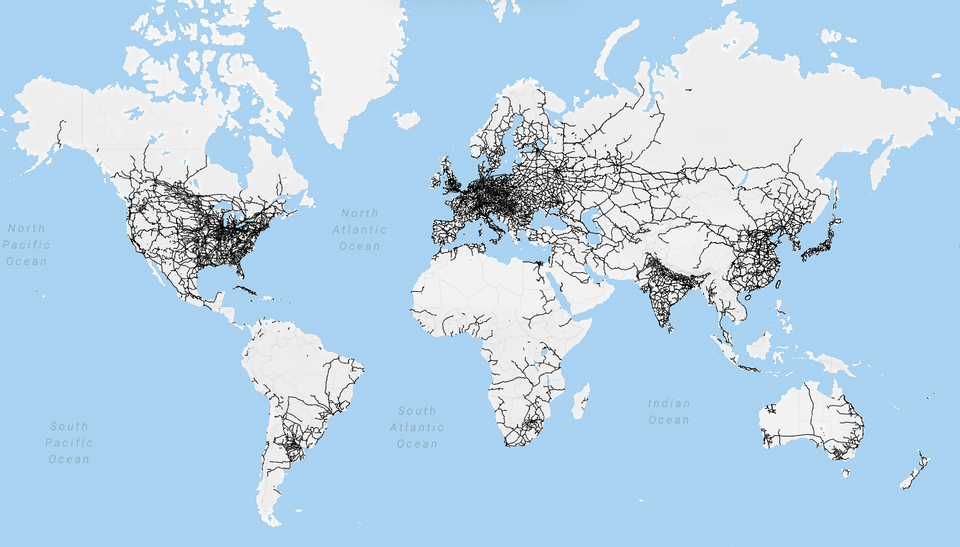
China and India, both nations whose economies have developed rapidly in the last twenty years, have already developed their railway systems.
Into the Future!
Let's take a look at the current global railroad networks overlaid on the Mercator map below:
Subscribe for more!
Quant Compass.

Member discussion