
QCI #120 - Is America Still a Rich Country?
Let's Talk Society!
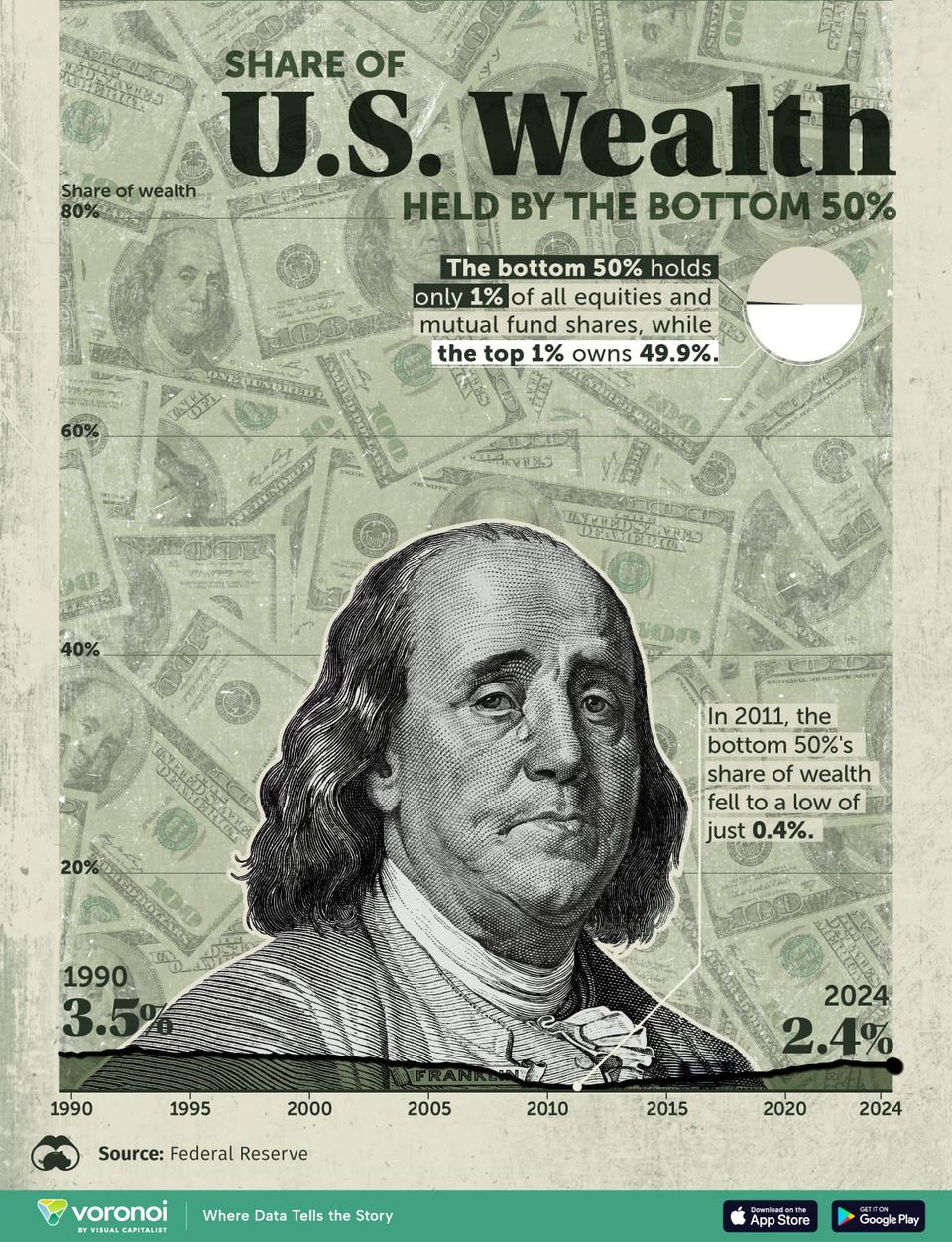
A country is as rich as its working class.
Net Worth = (Cash + Assets) - (Credit Card Debt + Loans)
The purpose of this post is to shed light on where Americans stand economically, to show that the American Dream is still very much alive, and to show that Social Mobility is still very much possible.
60% of Americans are living paycheck to paycheck. In terms of Net Worth, the bottom ~25% of Working Class Americans are in debt that they cannot fully pay off today. Above them in terms of Economic Resources, the next 35% of Americans are living paycheck to paycheck.
So let's cover Americans' Economic Social Classes by Net Worth Brackets:
The Working Class accounts for 50% of Americans Today. Where ~12% of Americans have more Debt than Assets, and thus a negative Net Worth, and ~13.2% of Americans have a Net Worth of $00.00 to $10,000. The top ~25% of Americans in the Working Class have a Net Worth of $10,000 to $100,000. Where ~6% have a $10,000 to $25,000 Net Worth, ~8% have a $25,000 to $50,000 Net Worth, and ~11% have a $50,000 to $100,000 Net Worth.
The Middle Class accounts for ~30%. Nationwide, the middle class generally holds a Net Worth between $100,000 and $750,000. The Lower Middle Class has a Net Worth of $100,000 to $200,000, and the Upper Middle Class has a Net Worth of $200,000 to $750,000. Approximately 16% of Americans have a Net Worth of $100,000 and $250,000, ~9% have a $250,000 to $500,000 Net Worth, and ~6% have a $500,000 to $750,000 Net Worth.
The Upper Class accounts for 19% of Americans; ~10% of Americans have a Net Worth of $750,000 to $1,000,000, and Millionaires account for 8.8%; excluding the value of their primary residence, 2.2% of Americans are liquid millionaires. 1.3% of that 8.8% have over ~$5mm, 0.06% have over $10mm, and Americans with $50mm or more account for only 0.05%.
Trickle-Down Economics is real; economic resources do not stay in the working class due to inflation, and inflation can be manipulated by international events orchestrated by multinational organizations.
Covering the American Spending & Investing Culture and Reality:
The American Middle-Class accounted for ~60% of Americans in the 1980's; today the Middle-Class accounts for just slightly over ~30%.
The Net Worth table and the "paycheck to paycheck" statistic make sense together because Net Worth measures long-term accumulated wealth, while living paycheck to paycheck measures short-term monthly cash flow. A household can have millions of dollars in Net Worth on paper but still have zero cash left over at the end of the month if their wealth is trapped in illiquid assets such as Real Estate and Retirement Savings. High Net Worth and Paycheck-to-Paycheck Living Co-Exist because a High Net Worth Individual's or Family's wealth is often locked up in home equity, retirement accounts, or a private business.
These families can be cash-poor or illiquid because they cannot easily spend their cash on daily groceries or monthly bills, usually due to taking on massive fixed costs: relatively expensive mortgages, private school tuition, high-end car leases, and steep tax brackets. While other individuals feel "paycheck to paycheck" because they automatically route their disposable cash into investments before seeing it.
Recently conducted US wealth surveys reveal that the richest Americans living paycheck to paycheck can have a Net Worth of $5 Million to $10 Million or more. A recent Goldman Sachs retirement survey revealed that 40% of Americans earning over $300,000 annually report living paycheck to paycheck. This is where the term Wealthy Hand-to-Mouth comes from: affluent individuals who are structurally wealthy yet constantly face liquidity constraints.
Another example is the Corporate Founder Trap, where it is common for business owners or startup founders to hold millions in illiquid company shares while paying themselves a modest base salary that barely covers their high-cost-of-living area.
Now, let's cover the US Economy:
The United States' real GDP is somewhere around $24.2T, because some sectors that account for just over 20% of Nominal GDP, report GDP for what they produce is priced, not what it is sold for after discounts, and not the cost to produce it, which is the accurate measure; While the Sovereign Debt on the Economy is ~40T.
The purpose of Sovereign Debt is to develop a Sovereign Nation to increase its Real Means of Production to the degree where the Sovereign Debt can be easily paid off through the new Means of Production financed by the issued Sovereign Debt, so that a Sovereign Nation does not have to sell off finite resources. If Sovereign Debt is issued for other purposes, those are all secondary. Furthermore, the US can no longer meet its coupon or interest payment obligations on its Sovereign Debt.
So if the United States is a rich country, why can it no longer meet its Debt Service or coupon payments on its Sovereign Debt, which is the primary purpose of issuing Sovereign Debt in the first place?
The American Dream is still real and alive, but if you judge a Nation by its bottom 25% in terms of economic status and standard of living, can the United States be considered a rich country?
Follow for more!
Quant Compass.
Member discussion